
Search “Google Ads vs Meta Ads” and you’ll get the same line every time: Google captures demand, Meta creates it. True, and almost useless on its own.
It doesn’t tell you where your next euro should go. Fifty-fifty? Eighty-twenty toward Google? Ninety-ten toward Meta? That’s the decision most DTC brands are actually making every month, and it’s rarely what gets answered.
Google Ads vs Meta Ads Which Is Better Misses the Point
Most comparisons are built like a shootout: cheaper CPCs, better ROAS, more control. That framing assumes you’re picking one platform. In practice, each platform has a different edge, and that edge aligns with different businesses in different ways.
Assuming you’re going to run ads on both, as most DTC brands eventually do, the shootout question doesn’t apply. The real question is how to allocate the budget to best meet your business goals.
Three things move it:
- Niche competitiveness – does your product get compared on price the moment it’s searched for?
- Product type – is it something people actively search for, or something they need to see first?
- Current objective – scale or profitability?
None of these decide the split alone. They stack.
Axis 1: How Competitive Is Your Niche on Google?
On Google, your product sits next to a price tag, inside a Shopping grid or a Search results page, where a buyer can compare five alternatives in one tab.
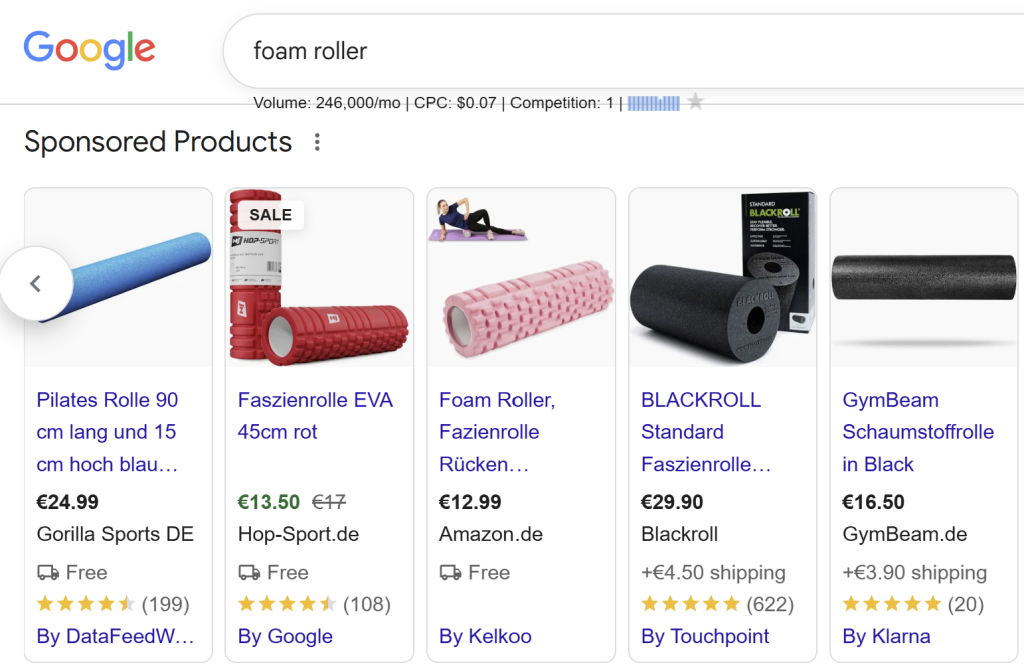
If your product looks functionally like everyone else’s, that comparison hurts you. Foam rollers are a clear example: a brand like Blackroll competes against a dozen cheaper look-alikes the moment someone searches “foam roller.” On Google, that’s a price fight it can’t fully win on message alone. On Meta, the same brand can lead with design, use case, and brand story before price ever enters the conversation.
Snocks, a 9-figure brand selling underwear and socks in Germany, is a clear example: structurally, most socks or underwear look the same in a Shopping listing. Search puts you next to whoever’s cheapest. Meta lets you build a narrative Search has no room for.
The more commoditized your category looks in a side-by-side comparison, the more that argues for leaning toward Meta.
Axis 2: Is the Product Searched For, or Discovered?
This is separate from brand differentiation. It’s about whether the category itself gets typed into a search bar at all.
If people already search for what you sell, running shoes, protein powder, a specific tool, Google Ads is catching real, existing intent.
If the product needs to be seen before it’s wanted, an “I didn’t know I needed this” product, a style-driven accessory, nobody is searching for it by name. That’s a Meta-first category almost by definition: discovery has to happen before intent can exist.
Some products sit in between: the category gets searched (people look for “sunglasses”), but not your specific take on it. In that case the split can be functional rather than either/or – Google for category-level terms, Meta to introduce your specific product against that same demand.
Worth a note: Google’s own Demand Gen campaigns are its attempt to compete on Meta’s side of this line, serving visual ads to people who haven’t searched yet. Useful to know it exists, but it’s a separate line item from the Search budget this framework is mainly weighing against Meta.
Axis 3: Profitability or Scale, Right Now?
This is the variable most comparisons skip entirely: not what the product is, but what the business is trying to do this quarter.
Google Ads tends to be the more profitable channel on a first purchase. It’s closer to the buying decision, so there’s less spend wasted on people who were never going to convert.
Meta is usually more expensive to acquire on that same first order. It pays off through what happens after: repeat purchase, retention, lifetime value. A supplements or consumables brand with strong repeat behavior can afford to look worse on day-one ROAS than a brand with a thin repeat curve, because the second and third order recover the gap.
A brand chasing growth this quarter, or one with retention strong enough to absorb a softer first order, can justify leaning further into Meta than a brand that’s currently protecting margin above all else.
Putting the Three Axes Together: A Google Ads vs Meta Ads Budget Split in Practice
These are illustrative starting points, not universal rules. The framework is the deliverable – the exact percentages should move with your own catalog, goals and results.
Scenario A: Commodity-coded, discovery-led, scaling.
A hypothetical DTC brand sells a mid-price home product that looks similar to several competitors, isn’t usually searched for by name, and has decent repeat purchase. The business is pushing for growth this quarter.
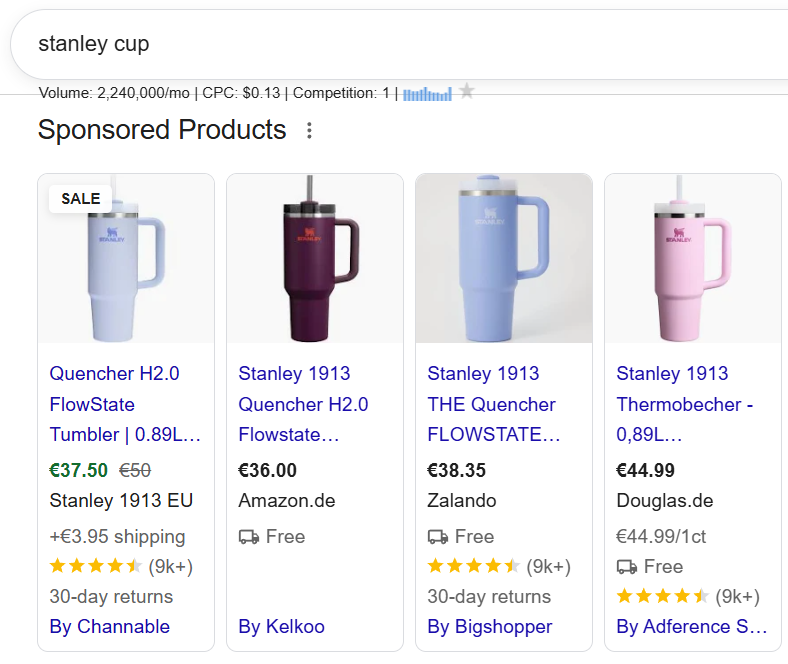
All three axes point toward Meta. A reasonable starting split: roughly 25-30% Google (mostly brand terms and the handful of category searches that do exist), 70-75% Meta. Stanley cup makes a good example.
Scenario B: Differentiated, searched, profitability-focused.
A hypothetical brand sells a specialized tool people actively search for by name or use case, is clearly differentiated from competitors, and needs the next quarter to be efficient rather than big.
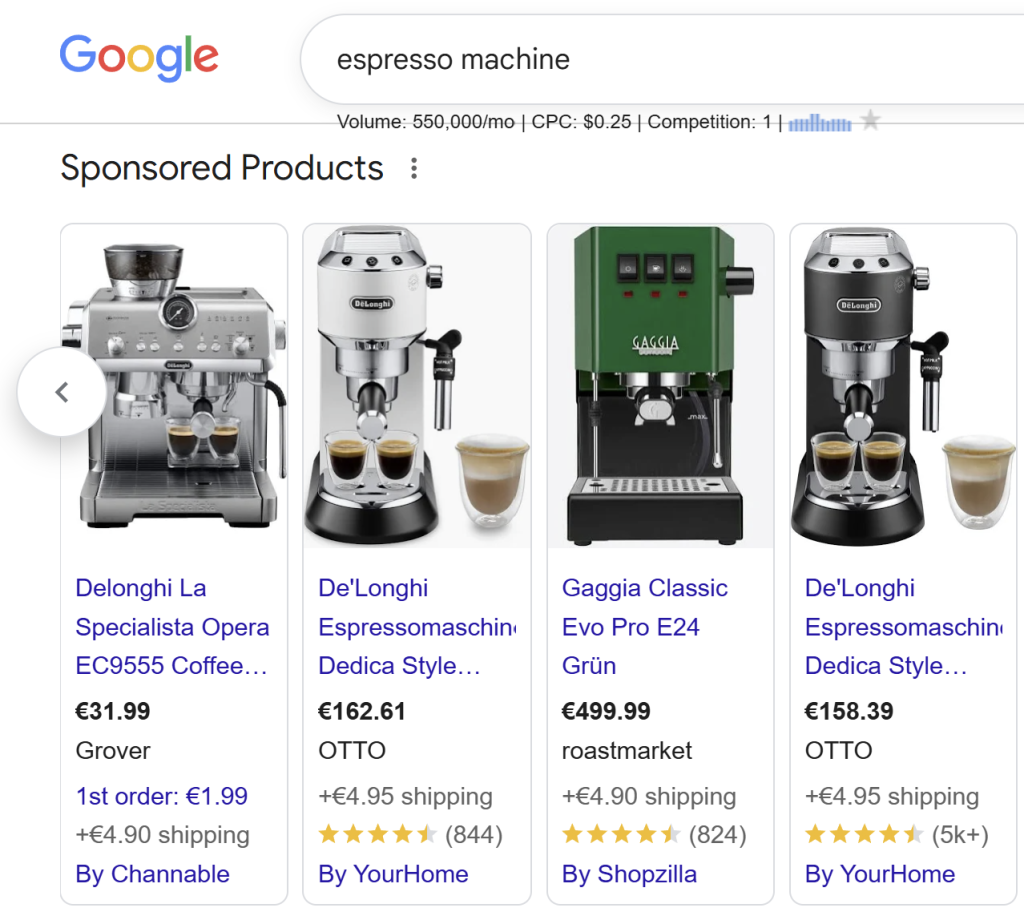
All three axes point toward Google. A reasonable starting split: roughly 65-70% Google, 30-35% Meta, weighted toward remarketing that supports the Google funnel rather than cold prospecting. An examle – Gaggia’s coffee machines.
Most real accounts land somewhere between these two, not at either extreme. Brands can also change the mix as they evolve.
Some DTC brands start with 90% of their budget spent on paid social to generate demand and win market share. Once this has been established, they shift budget to search. A good example here is Loop Earplugs.
When This Framework Doesn’t Work
Budget too limited to fund two learning phases at once
If total spend can’t give a second platform enough volume to get past its learning phase, splitting it just spreads a data problem across two accounts instead of solving it on one. Start with a single channel, optimize it, and only add the second once it’s producing reliable results.
The one exception: run a Google Brand campaign regardless, since it’s typically cheap to defend and protects existing demand while you build out the rest. Just don’t stay on a single channel indefinitely once budget allows for more – over-reliance on one acquisition channel is one of the more common ways DTC brands paint themselves into a corner.
A category with almost no presence on one platform
Some B2B or highly technical products don’t translate into an interest or behavior signal Meta can target. There’s no real audience to split into. Forcing a split where one side is structurally undersized just wastes the test.
A Facebook Ads Budget Strategy That Doesn’t Break Either Account
Once a starting split is set, the way you adjust it matters as much as the split itself.
Move in small steps. On Google, budget or target changes beyond roughly 20% can restart Smart Bidding’s learning period. On Meta, Business Help Center guidance on significant edits flags the same range for budget changes resetting an ad set’s learning phase. Either way, a 20% shift in a week is enough to knock the platform’s bidding algorithm out of a stable state, right when you need clean data to judge the change.
Check that each platform is tracking enough conversions to be judged at all before reading too much into its numbers. A platform running on a handful of conversions a month isn’t giving you a signal yet, on either side of the split.
Judge blended CAC and MER across both platforms together, not each platform’s own reported ROAS in isolation. Meta’s reported numbers routinely look worse than Google’s for the same sale in part because of how each platform attributes credit, not because Meta underperformed – Meta’s default attribution window is a 7-day click or 1-day view, while Google Ads defaults to a 30-day click window, so the same sale gets counted very differently depending on which dashboard you’re reading.
Give any new split at least two to four weeks before touching it again. Most of the damage in a Google Ads vs Meta Ads reallocation comes from adjusting before the data has caught up.
Google Ads vs Meta Ads: The Split Isn’t Fixed
“Google Ads vs Meta Ads” was never a question with a single winner. It’s a ratio, and it should move as your niche, your product, and your current priority move with it.
Run the three axes against your own catalog, pick a starting split, and treat it as a hypothesis worth testing, not a setting you configure once and leave alone.