

Introduction
In the era of automation, the way we write engaging copy for Google ads has fundamentally changed. We no longer craft a single, static message; we build a data set. With Responsive Search Ads (RSA) and Performance Max campaigns (PMax), Google’s algorithm requires up to 15 headlines and 4 descriptions to test millions of permutations in real-time.
The challenge is no longer just “writing a good ad.” The challenge is avoiding the “stuttering ad” – where three similar headlines appear together – and ensuring that no matter which combination Google picks, the ad remains coherent, persuasive, and high-converting. To do this, you need a system.
Understanding the RSA Machine
Responsive Search Ads work by mixing and matching your provided components. While this offers great flexibility, it introduces randomness. If you provide 15 headlines that all focus on the same value proposition, you aren’t giving the algorithm anything to test.
Moreover, traditional copywriting frameworks often fail here because they rely on a linear flow (Headline A leads to Headline B). In an RSA, Headline 15 could be paired with Headline 1 and Description 4. Recognizing this shift from “linear” to “modular” is the first step toward better performance.
The Constraints of Google Ads Copy
When writing Google Ads advertisers meet the following constrains:
Character Limits: You have exactly 30 characters for headlines and 90 for descriptions. There is no room for fluff.
Randomness: Unless you use pinning (which we will discuss), any headline can appear in any position.
Redundancy: If your headlines are too similar, e.g. ‘Buy Now’ and ‘Order Today’, you lose opportunities to target prospects who may react to different messaging.
The overall recommendation to beat these constraints is to think in groups.
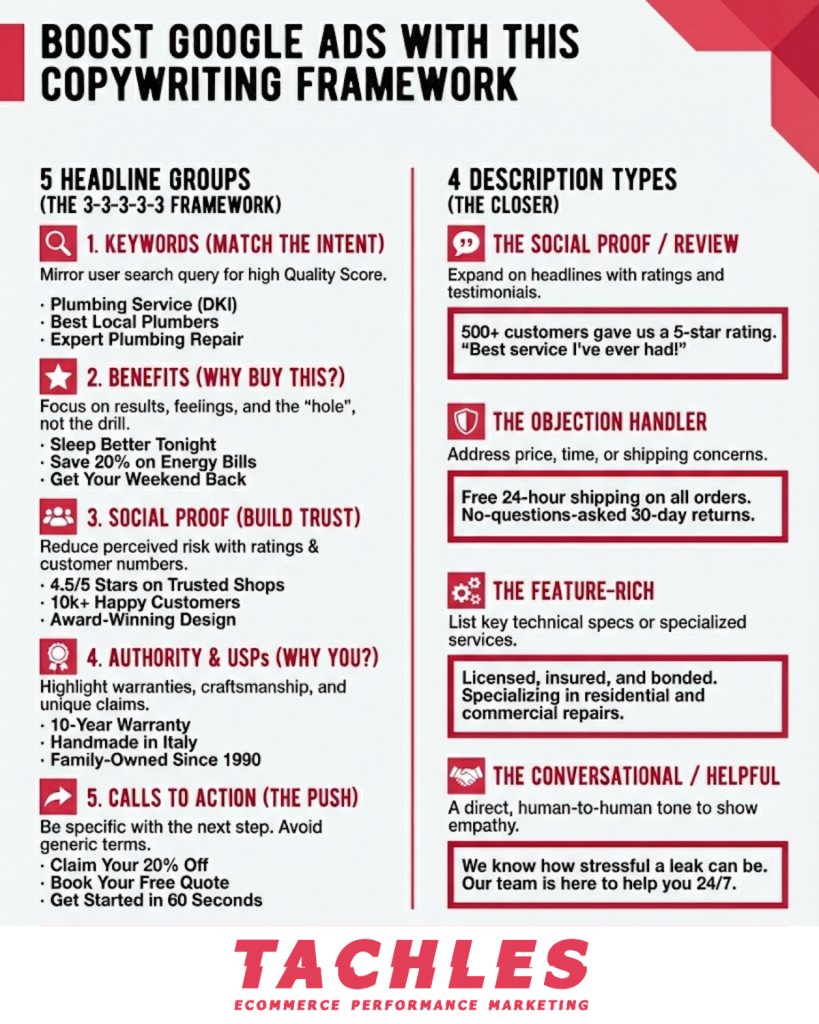
The 3-3-3-3-3 Framework
To maximize the algorithm’s ability to optimize, you must provide distinct “hooks.” Break your 15 headlines into five strategic groups of three. This ensures variety and prevents your ads from looking repetitive.
Group 1: Keywords (Match the Intent)
These confirm the user is in the right place by mirroring their search query exactly. Relevancy is the foundation of a high Quality Score.
- Headline 1: Match the exact search term with a dynamic keyword insertion (DKI)
- Headline 2: Use a close variation of the keyword
- Headline 3: Focus on the specific service category
Group 2: Benefits (Why Buy This?)
Focus on the result or the feeling the user gains after using your product. Don’t sell the drill; sell the hole in the wall.
- Headline 4: “Sleep Better Tonight”
- Headline 5: “Save 20% on Energy Bills”
- Headline 6: “Get Your Weekend Back”
Group 3: Social Proof (Build Trust)
Use social proof to reduce the perceived risk of clicking. People are more likely to buy when they know others already have.
- Headline 7: “4.5/5 Stars on Trusted Shops”
- Headline 8: “10k+ Happy Customers”
- Headline 9: “Award-Winning Design”
Group 4: Authority & USPs (Why You?)
Highlight warranties, specific craftsmanship, or unique selling points that your competitors can’t claim.
- Headline 10: “10-Year Warranty”
- Headline 11: “Handmade in Italy”
- Headline 12: “Family-Owned Since 1990.”
Group 5: Calls to Action (The Push)
Be specific about the next step. “Shop Now” is generic; “Claim Your Discount” is a directive.
- Headline 13: “Claim Your 20% Off”
- Headline 14: “Book Your Free Quote”
- Headline 15: “Get Started in 60 Seconds”
Why Grouping Helps
You might wonder why we don’t just write 15 unique headlines. Google can show up to three headlines at once. By having only three headlines per category, you guarantee that even if Google picks all three headlines from different groups, the ad remains diverse.
If you have 10 keyword-focused headlines, you risk an ad that says: “Plumbing Service | Best Local Plumbers | Expert Plumbing.” By using the 3-3-3-3-3 method, you get: “Plumbing Service | Rated 5 Stars | Book Online & Save.”
Optimizing Layout: “Mix Lengths” Headlines
If you write fifteen 30-character headlines, Google’s layout options are restricted.
By providing a mix of short (12-15 characters) and long (25-30 characters) headlines, you allow Google to potentially fit three headlines into a single ad unit.
Shorter headlines create “white space” that can make your ad stand out against a sea of dense text.
The 4-Description Masterplan
Descriptions are your “closer.” You have 90 characters to expand on the headlines. Since Google will pick two at most, ensure they highlight different angles:
- The Social Proof / Review: 500+ customers gave us a 5-star rating. ‘Best service I’ve ever had!'”
- The Objection Handler: Address price, time, or shipping. “Free 24-hour shipping on all orders. No-questions-asked 30-day returns.”
- The Feature-Rich: List 3-4 key technical specs or services. “Licensed, insured, and bonded. Specializing in residential and commercial repairs.”
- The Conversational / Helpful: A direct, human-to-human tone. “We know how stressful a leak can be. Our team is here to help you 24/7.”
The Pinning Question: To Pin or Not to Pin?
Pinning a headline to Position 1 or 2 is a common practice, but it comes with a cost. Google discourages pinning because it limits the machine’s ability to test.
When to Pin:
- An important promotional message: ‘Sale: 30% Off’.
- Ensure the Keyword is showing: If when looking at asset performance and combinations you notice ‘secondary’ headlines are showing more often than the main ones.
- Test pinning: It’s always a good idea to test pinning headline and/or description 1. Don’t mind the lower ad rank, performance may surprise you.
A Framework for Predicting Performance
To execute this copy strategy effectively, you need a process. Here is how I recommend approaching a new campaign:
- Review past winners: Look at old ads to see what worked or didn’t.
- Audit competitors: See what they are not saying. If they all talk about price, you talk about quality (Group 4).
- Map the 15 slots: Fill out your spreadsheet before touching the Google Ads interface.
- Check Ad Strength: Aim for “Excellent,” but don’t sacrifice good copy just to please the meter.
- Review Asset Details: After 30 days, check which headlines are getting the most impressions. Replace the “Low” performing assets with new ideas.
Common Mistakes To Avoid
- Forgetting the CTA: Writing 15 beautiful headlines but never telling the user what to do.
- Ignoring Asset Reports: Setting the ad and forgetting it. The “Asset Details” tab is a goldmine for learning what your audience likes.
- Over-Pinning: Pinning everything and effectively turning a Responsive ad into a static one.
Are 15 Headlines and 4 Descriptions a Must?
Filling in all headlines and descriptions isn’t a must. Google requires a minimum of 5 headlines and 2 descriptions.
While fewer headlines offer more control and reduce the randomness of how the ads appear, they also miss on the opportunity to discover winning combinations and reach more prospects.
That being said, I’ve seen ads perform well also with 10 headlines and 2 descriptions. But today I wouldn’t recommend less than that.
Is One Ad Enough?
With all these options, do advertisers still need to write 3 responsive search ads in each ad group?
I’d still recommend testing at least ads against each other, but they must be different enough, covering a whole different angle.
Conclusion
Mastering RSA and PMax ad copy is about balance. You are feeding a machine, but you are selling to a human.
By using the group framework, you increase the probability that your ads will make sense and convert.
Further Reading
- Seasonal Bid Adjustments in Google Ads: How to Use Them in 2026
- Master Search Impression Share to Boost Google Ads Performance in the AI Era
- Responsive Search Ads: Best Practices To Test And Optimize
- 26 Best Shopify Apps To Increase Sales
- Mobile First! 14 Actions To Improve Mobile UX and Increase CVR in Online Stores