

Introduction
Conversion rates naturally rise and fall throughout the year. Days like Christmas or New Year’s Eve often bring higher sales, followed by quieter periods. Recognizing these shifts helps Smart Bidding perform more accurately.
Seasonal Bid Adjustments can support your campaigns during these moments. They offer a way to immediately react to short, important sales windows.
Here’s what they are and when to use them.
Understanding Seasonal Bid Adjustments
Seasonal bid adjustments allow advertisers to tell Google they expect conversion rates will temporarily rise or fall during a specific period.
These signals help Smart Bidding react faster than it could on its own. The feature is designed for short events—typically hours or a few days—not long seasonal trends.
Smart Bidding can adapt to gradual changes, but it cannot instantly recognize that conversions will spike tomorrow morning because of a short flash sale or a surge in demand driven by weather or PR.
The goal of an SBA is simple: instruct Google that your campaigns should bid more (or less) aggressively during a defined window.
For example, if you know conversion rates typically rise 25% during a payday weekend, you can set an uplift and allow the algorithm to adjust bids accordingly.
Why Smart Bidding Needs Seasonal Signal
Smart Bidding can deliver excellent results over time, but it depends heavily on historical patterns. When something unusual happens—like a two-day flash sale—the algorithm is often too slow to respond.
Advertisers frequently lose impression share during short windows because Smart Bidding underestimates real-time intent.
During these moments, ads may enter fewer auctions, CPCs can rise unevenly, campaigns may hit budget caps earlier in the day, and high-intent hours might be lost. Seasonal bid adjustments act as a manual shortcut—an extra signal based on information that the algorithm has not yet learned.
When Seasonal Bid Adjustments Make Sense
Seasonal adjustments work best for short, predictable periods lasting roughly 6–72 hours. Anything longer begins to resemble normal seasonality, which Smart Bidding usually learns automatically.
While tROAS/tCPA adjustments usually take a few days to kick in and are hard to predict, SBAs are immediate and can be adjusted repeatedly to maximize results.
Typical use cases of SBAs include:
- Flash sales
- Black Friday, Cyber Monday, Christmas, Valentine’s Day
- Limited-time promotions or product drops
SBAs can also be used for more advanced use cases:
- Test impact of bid tweaks on campaign performance
- Force a higher or lower ad spend
- Advanced – mitigate gaps between actual and target ROAS
How to Set Seasonal Bid Adjustments in Google Ads
Creating a seasonal adjustment is straightforward:
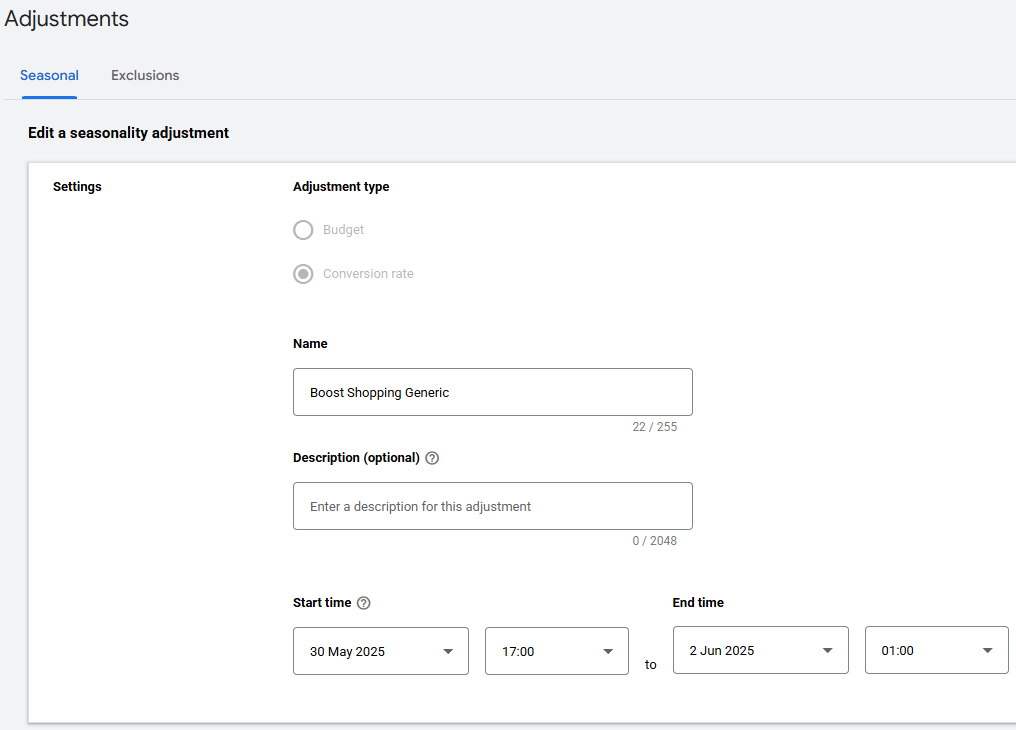
- Go to Tools → Budgets and bidding → Adjustments
- Create a new seasonality adjustment
- Adjustment type → Conversion rate
- Define the exact date and time window
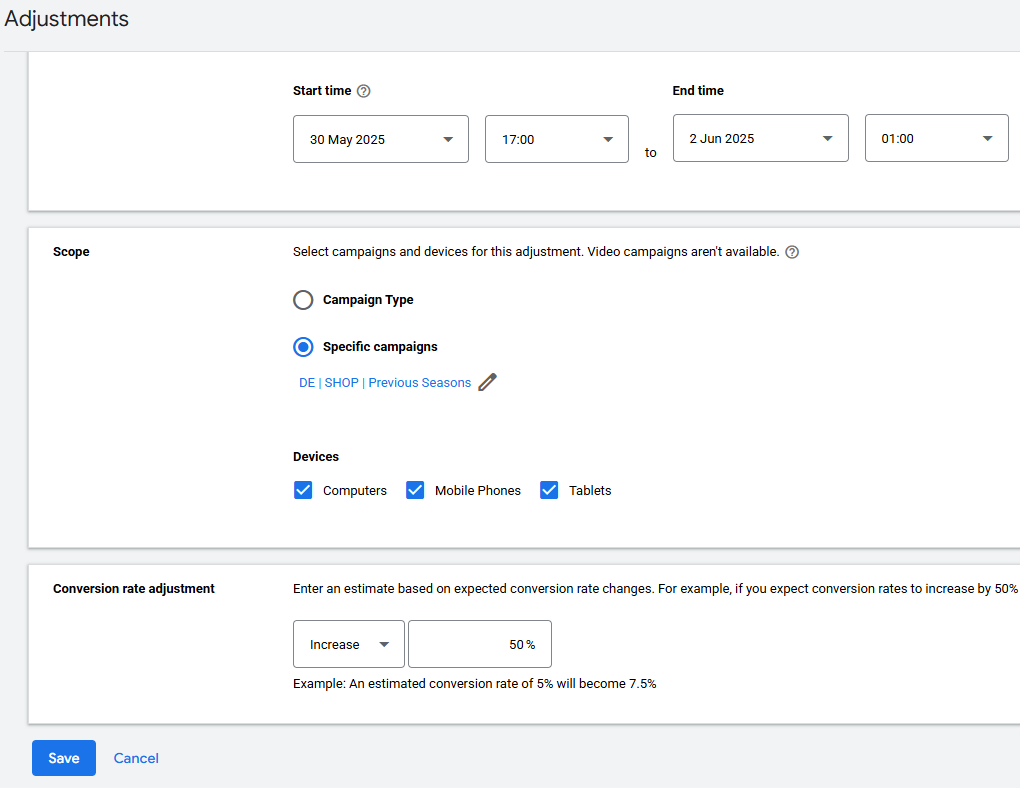
- Choose which campaigns and device types should be included
- Enter the expected conversion rate change
- Save and monitor performance closely during the defined period
How to Decide the Amount of Seasonal Bid Adjustment
Let’s take a look at the classic use case – Black Friday sale. You’ve analyzed last year’s performance, and found that the conversion rate on Black Friday was 3x compared to their average, and their AOV was 20% lower due to discounts.
Here’s how I’d calculate this:
To maintain the same ROAS, the key comparison is revenue per click (RPC) before vs. during Black Friday.
1. Compute relative change in RPC
- Last year’s CVR increased 3×
- Last year’s AOV decreased 20% → AOV = 0.8× baseline
RPC multiplier = 3 × 0.8 = 2.4
So during Black Friday, each click was worth 2.4× more revenue than on an average day.
2. ROAS relationship
ROAS = Revenue / Cost.
So, to maintain the same ROAS while revenue per click rises 2.4×, CPC can also rise 2.4×.
3. Required bid adjustment
A 2.4× CPC allowance = +140% increase in bids
So if your normal CPC is $1, you could theoretically afford up to $2.40 while maintaining the same ROAS.
The higher bid should allow you to maintain visibility while competitors bid more aggressively.
A Framework for Predicting Seasonal Performance
To execute seasonal adjustments effectively, forecasting is essential. Here is a simple framework:
- Review last year’s data.
- Analyze the last 30–60 days.
- Identify demand triggers.
- Estimate uplift based on past performance.
- Align budgets to ensure campaigns do not cap prematurely.
Common Mistakes Advertisers Make
- Not monitoring results in real time (and adjusting if necessary)
- Running adjustments for too long
- Overestimating uplift without looking at data
- Forgetting to increase budgets
- Applying account-wide adjustments unnecessarily, e.g. on brand campaigns
- Overlapping seasonal windows
Conclusion
Seasonal bid adjustments give advertisers a powerful way to guide Smart Bidding during short-term demand spikes. When paired with thoughtful budgeting, they help maintain impression share, increase ROAS, and take full advantage of customers’ peak buying moments.
Brands that prepare for these seasonal opportunities consistently outperform those that leave everything to the algorithm.